US Markets Overnight: What a weird session
Thursday’s session in the US on 4 June was one of those magnificent split-screen days where the top half of the market threw a tantrum and the bottom half threw a block party. Broadcom cratered nearly 13% after its AI chip guidance failed to impress the crowd, dragging semiconductor names through the mud. But rather than panicking, the rest of Wall Street simply rotated with the enthusiasm of a punter switching from the 3:15 to the 4:00 at Randwick. The Dow ripped 875 points higher on a surge in healthcare, financials and real estate, while Alphabet popped 3.8% on a fresh AI partnership with Palantir. US markets overnight delivered a session that was less about fear and more about where the next dollar of capital was heading.
Rotation a go go
The S&P 500 added 0.4% to close at 7,584, a quiet gain that masked enormous churn beneath the surface. Eight of 11 sectors finished green, with healthcare up 3.1% and financials up 2.7%, while tech was the conspicuous laggard. The Nasdaq Composite dipped a barely perceptible 0.1% to 26,831, dragged lower by chip stocks despite the Magnificent 7 collectively contributing positive weight. The Dow stole the show, surging 1.7% to 51,561, just shy of its all-time high set earlier in the day, as old-economy names reminded everyone they still exist. The Russell 2000 climbed 1.6% to 2,939 as small caps rode the rotation wave.
In commodities and macro land, WTI crude tumbled roughly 4% to around $92 a barrel after Israel and Lebanon agreed to a ceasefire (conditional on Hezbollah signing on), while Trump dangled the prospect of progress with Iran by the weekend. Gold loved the geopolitical optimism, climbing above $4,500 an ounce as the dollar softened. Bitcoin, however, continued its brutal unravelling, sliding to around $63,650, down over 13% for the week and now below its pre-war level. The US 10-year Treasury yield hovered around 4.48%, buoyed by a stronger-than-expected ADP jobs print that reinforced expectations of a possible Fed rate hike later this year. The VIX slipped to around 15.6, suggesting the broader market was not especially worried about Broadcom’s meltdown.
Alphabet finally gets its flowers
Alphabet ($369, +3.8%) was the undisputed star of the Magnificent 7 in US markets overnight after announcing a multi-tiered partnership with Palantir that integrates BigQuery with Palantir’s Foundry platform and connects Palantir’s AIP with Google’s Gemini large language model. The market read it as yet another proof point that Google Cloud is becoming the infrastructure layer for enterprise AI. With the stock up roughly 160% over the past year, Alphabet is making a persuasive case that it owns, as one analyst put it, most of the AI stack.
Nvidia ($219, +1.8%) shrugged off the Broadcom contagion with admirable composure, perhaps because CEO Jensen Huang was too busy touring Asia, concluding his Computex and GTC Taipei appearances before heading to South Korea for meetings with SK Hynix and Samsung. When the chip kingpin doesn’t flinch, it sends a signal. Amazon ($254, +1.5%) continued its steady grind higher, quietly benefiting from the AI infrastructure spending cycle without attracting the kind of headline risk that finds Broadcom. Meta ($628, +0.7%) was modestly higher as the market digested its role as both AI spender and AI beneficiary.
Apple ($311, +0.3%) and Microsoft ($428, +0.2%) were essentially flat, treading water ahead of Apple’s WWDC event next week where Morgan Stanley sees potential upside from new AI features. Tesla ($418, -1.2%) was the lone decliner in the group, continuing its drift lower as the SpaceX IPO on 12 June approaches and investors weigh whether to reallocate Musk-adjacent capital. The broader concern is straightforward: if SpaceX prices at $135 a share and attracts retail enthusiasm, some of that money is almost certainly coming out of Tesla.
Broadcom swings the wrecking ball through semiconductor land
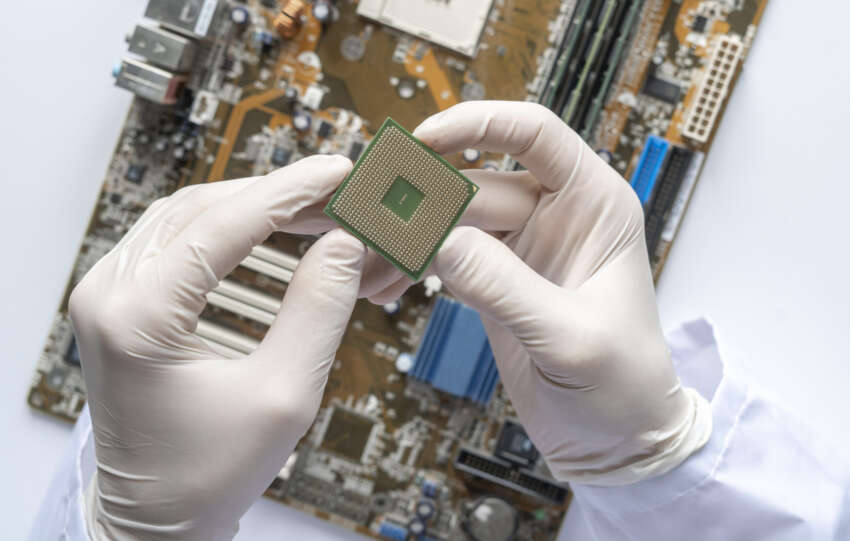
Broadcom ($418, -12.9%) was the session’s villain after reporting fiscal Q2 numbers that technically beat on both revenue ($22.19 billion) and adjusted EPS ($2.44), but disappointed badly on its AI chip sales outlook. The company reiterated rather than raised its full-year 2026 guidance, and in a market that had priced semiconductor names for perfection after a blistering rally, reiterating guidance was as good as a downgrade. As we recently wrote on Stocks Down Under, the semiconductor sector’s margin for error had become approximately the width of a 2-nanometre gate. Broadcom just proved it.
The fallout was broad. ARM Holdings tumbled 6%, Micron lost around 5%, Qualcomm fell 3%, AMD slipped 2.3% (recovering from an intraday low of nearly 8% down), and Intel shed 2%. The iShares Semiconductor ETF (SOXX) tracked its worst session since late March. The one name that bucked the trend was Marvell Technology, which opened lower, but flipped into positive territory after Nvidia’s Huang had earlier in the week called it the next trillion-dollar company. In US markets overnight, the semiconductor space provided a useful reminder that even the hottest sectors can have a very bad day when expectations run too far ahead of reality.
One thing worth watching
All eyes turn to Friday’s May nonfarm payrolls report, with analysts expecting a modest 85,000 jobs, historically light and down from 115,000 in April. After this week’s strong ADP print and robust JOLTS data, a hot number could push rate hike expectations further and add to the pressure on growth names. Markets now price an 85% chance of a quarter-point Fed rate hike by year end, up from 60% a week ago, so the stakes are real. For Australian investors watching US markets overnight, the jobs print will set the tone for next week, which also brings CPI data on 10 June and an ECB rate decision on 11 June.