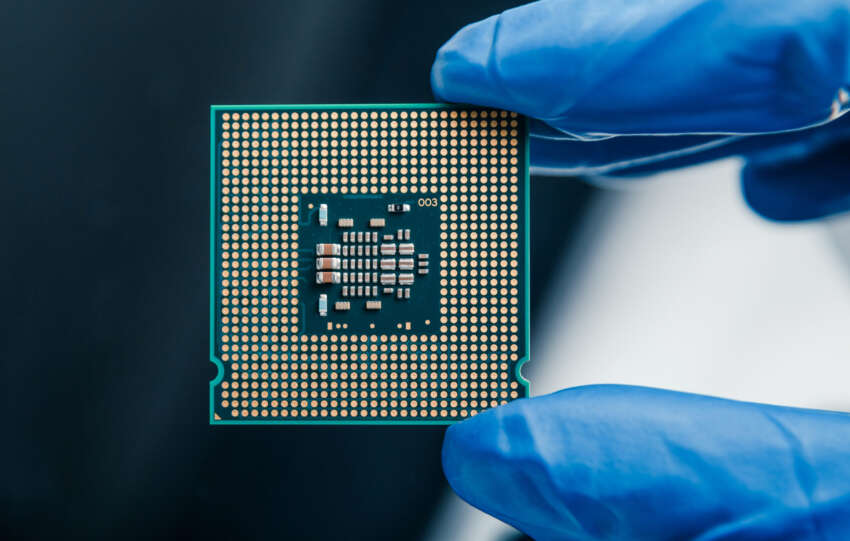
Design completion is not the milestone that moves a semiconductor company from interesting to credible. Fabrication entry is. Nanoveu (ASX:NVU) crossed that line in the March quarter, with its subsidiary EMASS completing tape-out of the 16nm ECS-DoT chip and commencing fabrication at TSMC.
That is a materially different stage of development from the 22nm commercial platform that has been driving near-term customer design-in activity.
The 16nm chip is not a marginal upgrade. It integrates Bluetooth Low Energy directly into the system-on-chip, removing the need for a separate wireless component and reducing both board space and bill-of-materials cost for OEM customers.
Expanded on-chip SRAM supports larger neural networks, and the new power management architecture is optimised for always-on operation at sub-milliwatt power levels. These are the specifications that determine whether edge AI chips get designed into volume products.
The company also completed a placement raising A$7.38 million in the first tranche at A$0.088 per share. Cash at 31 March 2026 was A$6.672 million, giving approximately 3.1 quarters of operating cash runway at the current burn rate of A$2.163 million per quarter.
Why the NTU Drone Swarm IP Changes the Commercial Addressable Market
The exclusive evaluation licence with Nanyang Technological University covering four GPS-free localisation and drone formation control inventions is strategically significant in a way that the headline does not fully capture.
ECS-DoT has already demonstrated average flight endurance gains of 57% to 60% across drone form factors in Phase 2 hardware-in-the-loop trials. Adding GPS-free navigation capability on the same hardware platform moves the value proposition from battery optimisation to full autonomy.
GPS-free operation is increasingly a hard requirement for defence and industrial drone applications, where GPS jamming or denial is a real operational constraint. If Nanoveu can integrate the NTU portfolio with the ECS-DoT endurance advantage, it creates a combined autonomy and efficiency platform that addresses a much larger pool of potential customer programs than endurance alone.
Live drone flights are expected imminently, supported by a US-based specialist drone technology group engaged to validate performance across additional platforms. That is the next concrete milestone for investors to watch, because positive live flight data with third-party validation changes the nature of the commercial conversations Nanoveu can have with potential customers.
The Hearables Reference Design Is an Underappreciated Commercial Pathway
The bone-conduction hearables reference design launched in partnership with STMicroelectronics targets the wearable AI market, which is projected to exceed US$232 billion by 2030. The design uses STMicroelectronics’ inertial sensing unit to detect jaw movement, waking the ECS-DoT audio subsystem only when the user is likely speaking. This eliminates continuous microphone monitoring, which is the main source of battery drain in current always-on wearable devices.
The relevance of this design for commercial progress is that reference designs are how semiconductor companies demonstrate to OEM customers that their chip is ready for specific application categories. Showcasing the design at Embedded World 2026 in Nuremberg gives EMASS direct access to the European OEM ecosystem, which is one of the most important end markets for precision wearable and industrial sensing devices.
Investors’ Takeaway for Nanoveu
The March quarter positions Nanoveu at the transition point between a development-stage semiconductor company and one with silicon in fabrication, a funded commercial roadmap, and expanding application reach. That is a genuine step forward, but it also means the next phase carries its own execution risks.
Silicon validation is not guaranteed. Tape-outs at TSMC succeed at high rates for experienced design teams, but first silicon frequently requires iteration before it meets all performance targets. The 3.1 quarters of cash runway means Nanoveu will likely need to raise further capital before or during the commercialisation phase if design-in cycles extend beyond current expectations.
The upside case is that positive 16nm silicon results, combined with successful live drone validation and progress on OEM design-in activity for the 22nm platform, create a convergence of proof points that support both commercial momentum and a rerating of the stock. For investors comfortable with early-stage semiconductor risk, Nanoveu is now at the stage where the technical story is transitioning into something market-facing. More coverage of ASX-listed technology and semiconductor names is available at Stocks Down Under.