What does it take for directors to sell shares in their company? And is this a big deal – given it can be perceived as a sign of no confidence in the company, you would think there would be good reasons. Some of the most common include paying tax bills or selling to institutional shareholders. But, every now and again, there are some reasons directors sell shares that raise eyebrows. And in any event, it can be a cause of investor concern. Just look at DroneShield, which dropped by more than 50% in the aftermath of directors Oleg Vornik, Peter James and Jethro Marks selling over $70m worth of shares.
Let’s take a look at the general question of whether or not it is a big deal when directors sell shares.
What are the Best ASX Stocks to invest in right now?

Is it a bad sign when directors sell shares? It can be
Overall, it can be perceived as a bad sign. Well, at least investors perceive it is, because why would they be selling if they are confident? Of course, if directors go the other way (buying blocks of shares), it is no guarantee of success, but that is for another article.
As we’ve noted, the reason DroneShield got its investors panicked is because the shares were sold at the top and have come down significantly. Had the directors waited, they would’ve realised far less upside. And even if they were to buy some of those shares back, it’d they’d still have pocketed a fair amount.
Now of course, it is only illegal to sell if directors engage in insider trading and they could also get into trouble if they sell during a ‘closed period’ (i.e. a period when directors are banned from trading in shares, usually just before results). But even if directors have a reason, it is a bad look if they sell (especially if it is a big amount). Directors will usually try to justify themselves, and sometimes they have good reasons.
There have been a number of cases where director trades have symbolised the beginning of the end of a company, even if they were not uncovered until after the fact. When Enron collapsed, it emerged that multiple Enron executives, including CEO Jeff Skilling and Chairman Ken Lay, sold large amounts of shares while publicly promoting the company’s health. Ironically enough, other employees were restricted. We all know how Enron worked out. This was also the case in the collapse of Lehman, WorldCom, Countrywide Financial, as well as (closer to home) HIH and ABC Learning Centres.
Now of course, the share-sale issues formed part of the broader misconduct picture rather than standalone insider-trading cases, but many shareholders who lost everything would be most bitter over the trading. Some went to jail for things other than insider trading such as misleading statements and director duty violations.
It isn’t always a bad sign
A number of big share sales by directors in ASX-listed companies in recent years have been explicitly justified as being to pay tax: NEXTDC’s CEO, Cleanaway’s MD, etc. This is a common and legitimate reason, though it can still make investors uncomfortable (especially if the amounts are very large).
It is important to note that directors’ sales always need to be disclosed via Appendix 3Y notices. Good corporate governance typically requires that such trades are pre-approved (especially for insiders) and are done within trading window. Some may say that “selling to pay tax” might sometimes mask opportunistic timing — i.e., if insiders know good or bad news is coming, they might top-slice when it’s favourable. Of course, they can only be prosecuted if the directors know the bad news for sure and it is not publicly avaliable information. Mere feelings that no one can tell are insufficient.
The bottom line we’re trying to illustrate is that not all such instances directors sell shares equal wrongdoing. Many are legitimate, with full disclosure. The problem for investors is assessing which are genuinely benign and which might warrant caution.
4 of the strangest reasons we’ve ever heard directors sell shares in their company
Kirsty Carr from Bubs – buying a house
Back in 2019, nearly 4 years prior to the day of her unceremonious exit in 2023 from the company she founded, Mrs Carr netted $5.8m from selling shares in the company. The reason given? To buy a house. ‘Mrs Carr has advised that the sale of the shares was for entirely personal reasons to acquire a new family home,’ the company told investors.
Miriam Adelson from Las Vegas Sands – buy Dallas Mavericks
This was the whole inspiration behind this article. Mrs Adelson is the widow of the former boss of Las Vegas Sands Sheldon Adelson, who died in 2021 and held a majority stake in the company. Mrs Adelson does have a reputation of her own, as prominent medical doctor and philanthropist, focused on causes that improve Jewish relations in the United States. In 2023, the company announced that it would sell US$2bn of shares, equating to 10% of her stake to buy the Dallas Mavericks.
OK, it didn’t specifically mention the Mavericks. ‘We have been advised by the Selling Stockholders that they currently intend to use the net proceeds from this offering, along with additional cash on hand, to fund the purchase of a majority interest in a professional sports franchise pursuant to a binding purchase agreement, subject to customary league approvals,’ Las Vegas Sands said in the filing. However, with Mark Cuban recently announcing he would sell the Dallas Mavericks, it is difficult to see what other franchise it would be given how few others are on the market. The company agreed to buy US$250m of those shares.
David Dicker from Dicker Data – buying cars, a private jet and US shares
This made the Sydney Delta lockdowns bearable. It is said that a picture is worth a thousand words and in our view, there is no better a case study of the truth of that statement than here.
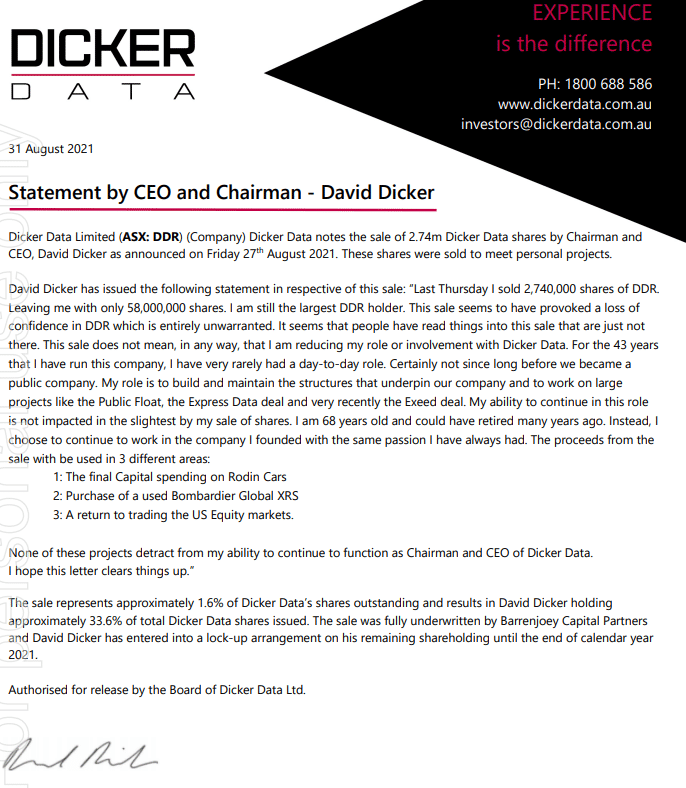
As you can see, the sale caused some panic amongst shareholders that the founder was stepping away from the company. So, Mr Dicker felt the need to ‘correct the record’ and so he did with a touch of honesty you usually don’t see. After all, surely at least some directors who sell to institutions may’ve done one or two of those things, especially when they say they are ‘diversifying’ their portfolios.
Kelsian director Neil Smith – charity venture.
These shares were not directly owned by Mr Smith, instead by a trust in which he is a beneficiary. A $5m package was sold in 2023, apparently for a good cause. “The principal use of the proceeds of the disposal will be to further support charitable projects undertaken by a UK registered charity called The Relay Trust of which Mr Smith is a trustee,” the announcement said.
“The projects supported by The Relay Trust are educational and community infrastructure projects in Sudan, South Sudan, Madagascar, Mozambique, Angola and Sierra Leone.”
Furthermore, the announcement said Smith participated (through Relay Australia Pty Ltd as trustee for The Relay Trust Australia) in the recent KLS capital raise associated with the proposed acquisition of All Aboard America! Holdings, Inc. “Mr Smith has advised Kelsian that there are no changes in Kelsian’s circumstances influencing his decision to dispose of these shares,” the announcement said.
Smith was one of the founding shareholders and former chair of the Transit Systems Group before the acquisition by Sealink.
What are the Best ASX Stocks to invest in right now?
Check our buy/sell tips