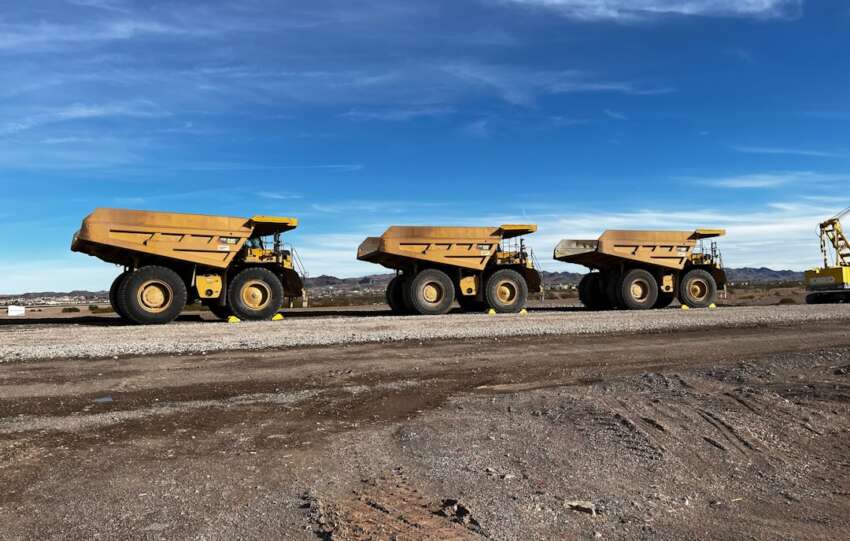
New DHEM conductors at Evanston and Golden Orb sit outside the 342,300oz resource shell
Leeuwin Metals (ASX:LM1) has just kicked off a 5,000m reverse circulation drill program at its Marda Gold Project near Southern Cross in Western Australia. The campaign is the first real test of the company’s growth thesis since it delivered a maiden 342,300oz resource at Marda back in December 2025.
What makes this program interesting is not just the size. It is the spread of targets the rigs are being pointed at, and the quality of the rock chip results that have already come from some of them.
Prior surface sampling at Atkinson Find and Allens Find returned peak gold assays of 209g/t, 62.4g/t, 49.2g/t and 40.6g/t. Those are not subtle numbers. They sit alongside 11 north-south structural trends that have barely been drilled, plus two newly modelled down-hole electromagnetic (DHEM) anomalies at Evanston and Golden Orb that fall outside the current resource envelope.
DHEM, in plain English, is a survey technique that detects conductive sulphide bodies underground. At Marda, gold is associated with pyrite, so a strong conductor is a credible proxy for a potential mineralised lode. That is why the new anomalies matter.
The 342,300oz resource is the floor, not the ceiling
The maiden resource at Marda sits at 2.1Mt at 1.1g/t for 73,800oz Indicated and 8.1Mt at 1.03g/t for 268,500oz Inferred. It is a useful starting position for a junior explorer, but at just over 1g/t average grade it needs scale or higher-grade additions to become a development story.
Today’s drill program is designed to add both. Extension drilling around the existing resource targets scale. The Atkinson Find and Allens Find work, plus the 11 under-drilled structural trends across Marda Central, targets grade. If the program delivers even modest hits along those high-grade trends, the resource arithmetic changes meaningfully.
That is the more interesting half of the campaign. Resource extensions are incremental. New high-grade discoveries are step changes.
What the new DHEM conductors actually signal
The Evanston anomaly is roughly 150m by 130m and sits outside the current resource shell. Golden Orb’s footwall conductor is larger again at 165m by 165m, also outside the existing envelope. Both will be drill tested as part of this program.
Conductors of that size are not guarantees of gold. They are guarantees of something dense and electrically responsive underground, which in this geological setting tends to mean sulphides. Whether those sulphides carry economic gold grades is precisely what the drill bit will answer over the coming months.
Our take is that the Golden Orb conductor is the more interesting of the two. It is larger, it sits in the footwall of an already-mineralised system, and it is the kind of target that, if it hits, materially reshapes how the market thinks about Marda’s geological endowment.
Funding is in place, which removes the usual junior explorer overhang
Management has flagged the company is well funded for the program. For a small-cap explorer about to drill 5,000m across multiple targets, that is the single most important line in the announcement.
The reason matters. Junior gold explorers frequently announce ambitious programs and then have to raise capital mid-drill, usually at a discount and usually just as results start arriving. That dynamic caps share price upside even when the geology is working. Leeuwin’s funded position means the next few months should be about assays, not placement bookbuilds.
The Investors Takeaway for Leeuwin Metals
First assay results from the 5,000m program are expected in the coming months. That is the catalyst window investors should be focused on. Hits along the 11 north-south trends or inside the new DHEM conductors would be the events that push Marda from advanced explorer to credible development candidate.
We think the risk-reward setup here is reasonably balanced. The floor is supported by a real resource of 342,300oz. The upside is multiple under-tested targets that have produced eye-catching surface samples and credible geophysical anomalies. The risk, as always with exploration, is that drill holes can validate a target or kill it, and the market reaction is asymmetric on the downside.
For investors wanting more in-depth coverage of ASX-listed gold explorers at the drill-results stage, stocksdownunder is a good place to start.