Ross Stores (NDQ:ROST): Nearly US$23bn in revenues from serving America’s depraved working class

Nick Sundich Nick Sundich, March 16, 2026

Ross Stores (NDQ:ROST) is an S&P 500 company that is well and truly for the working class, being America’s largest discount apparel retailer.

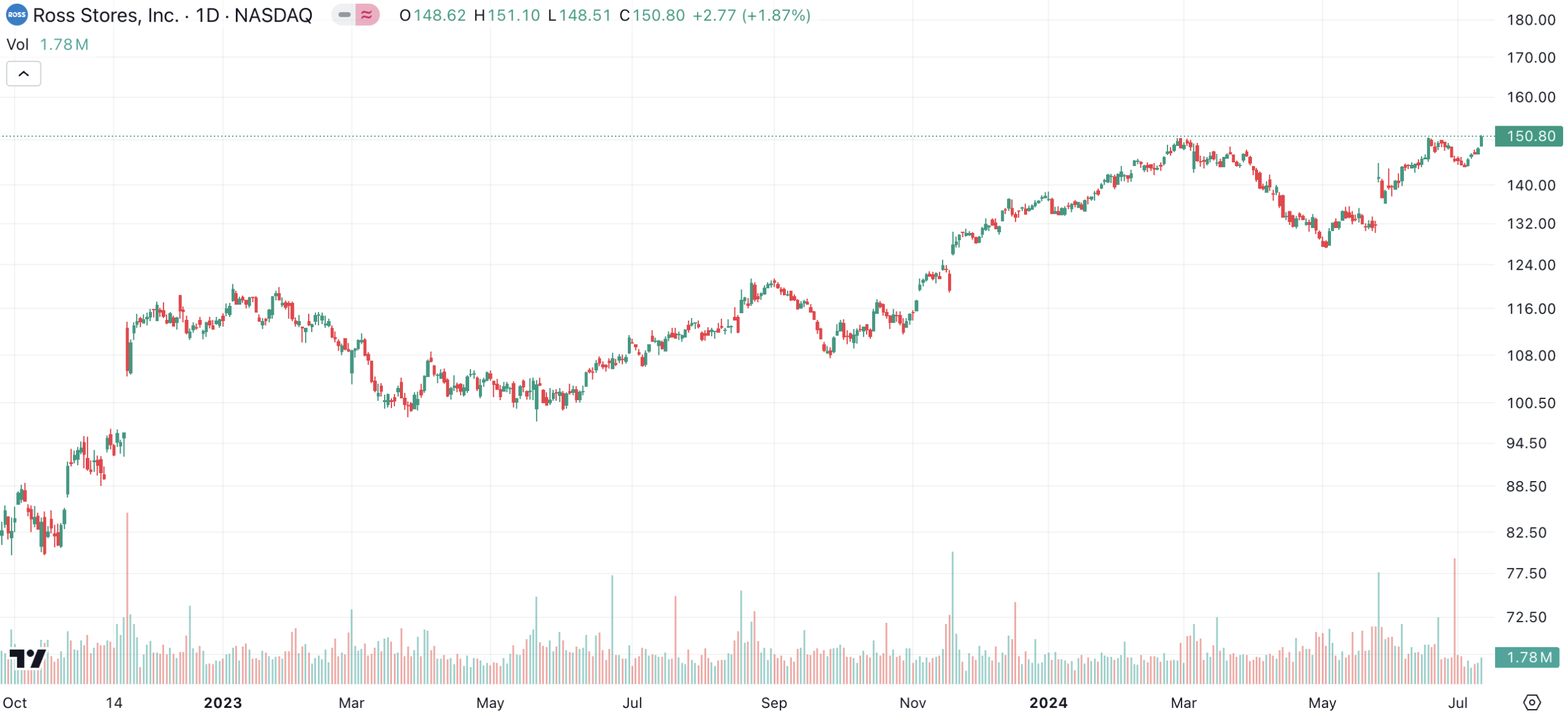
Even though the US economy is going strong and inflation is coming under control, this is not necessarily being felt across the country. This has been reflected in the company’s sales (surpassing US$20bn for 3 years running) and in its share price growth in the last 12 months (over 65%).

What are the Best ASX Stocks to invest in right now?

Check our buy/sell tips

The history of Ross Stores (NDQ:ROST)

The company is headquartered in Dublin, California. From San Francisco, you cross the Bay and you drive through a valley that is half-way between Oakland and Fremont. That broader region is called the ‘Tri-Valley’. How did Ross end up there you might ask? It has always had roots in the San Francisco Bay Area and has shifted its headquarters a number of times. It has been in the ‘Tri-Valley’ area since moving from Newark (not Newark in New Jersey but in California adjacent to Oakland) in 2003, initially to Pleasanton and then to Dublin which neighbours Pleasanton. Of course, as is the case with many US corporations, it is incorporated in Delaware.

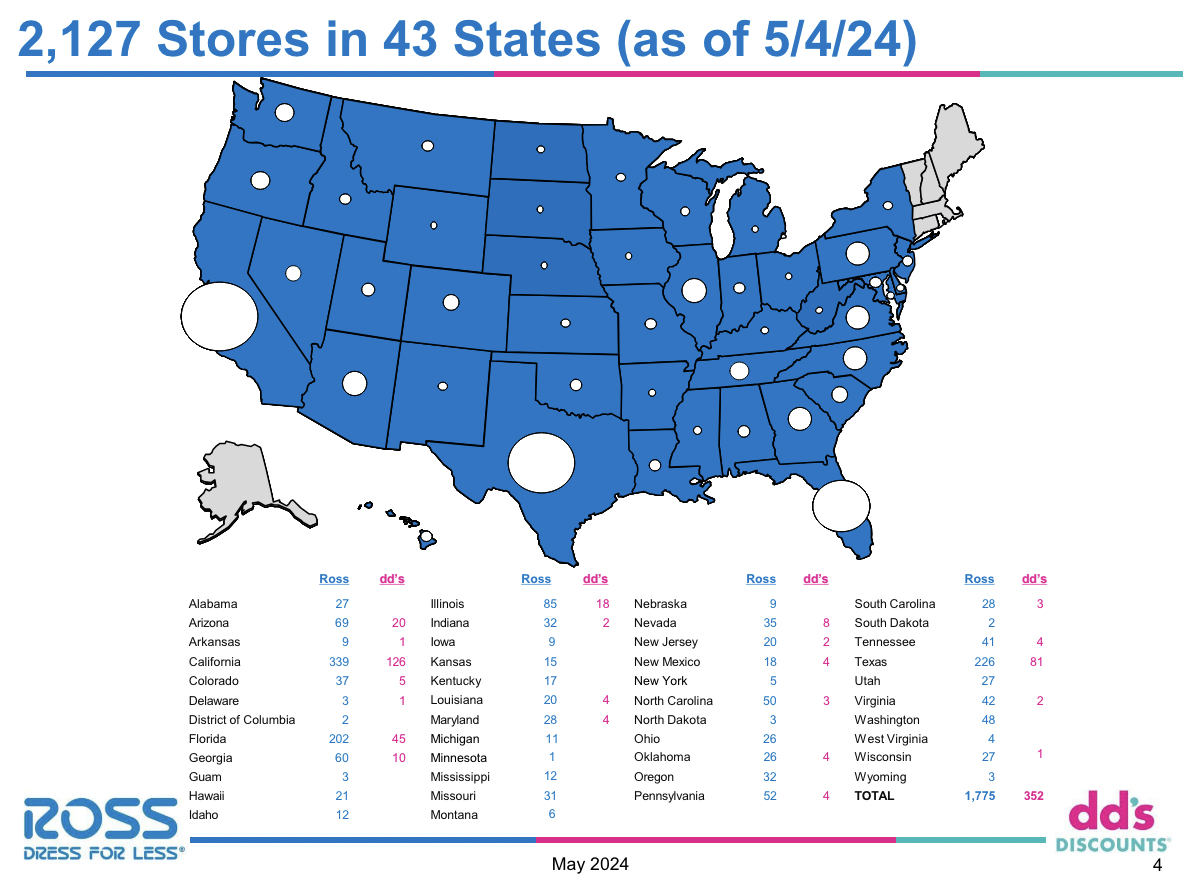
The first store was opened in 1950 by Morris ‘Morrie’ Ross, who the company remains named after. Between 1958 and 1982, the company was owned by William Isackson, and then it was sold to a group of investors led by Mervin Morris, the founder of Mervyn’s. By this point it had 6 stores, but this rapidly expanded – reaching nearly 300 stores by the end of 1995. Today, it has nearly 1,800 stores in its own right and roughly 350 stores operating under the dd DISCOUNTS brand. The two chains share some corporate and support services, but have distinct merchant, store field and distribution operations.
Ross’ Business model

The company aims to provide apparel at 20-60% below department and specialty store prices at Ross and 20-70% at Discounts. Stores receive merchandise 3-6 times a week and they are designed to be a ‘treasure-hunt’-like shopping experience. Brand name labels are left on so that shoppers will identify with particular brand.

Ross Stores has a large network of merchandise and vendors from whom the company buys directly, typically later in the merchandising buying cycle than department or specialty stores. They sell to Ross to sell something they otherwise would not have, and in return Ross does not require the conditions other stores do (such as requiring allowances or shipments to be dropped directly to stores rather than distribution centre).

70% of its customers are females, who shop for themselves and other family members. They tend to visit two to three times a month and while they engage with digital channels to find them, they go in store to shop. This is why Ross has held back on embracing eCommerce to the extent many of its peers have. This hurt the company during the pandemic in a way that many of its competitors (with online shopping options) did not. Nonetheless, eCommerce is far lower margin than in-store, which is why Amazon has tended low single digit margins, while Ross’ operating margin is just above 10%.

Will momentum continue for Ross Stores? 2025 shows good signs

The company has just completed fiscal 2025 with record full-year sales of $22.8 billion, comparable store sales growth of 5%, and earnings per share of $6.61, likewise 5% growth. This result capped off a year that started with considerable uncertainty around tariffs and consumer softness (both generally and related to tariffs) but finished with genuine momentum.

Those are the sorts of numbers that remind you why off-price retail is considered a defensive-growth category: when consumers feel squeezed, they trade down to Ross rather than away from it entirely. The back-to-school season was strong, new marketing campaigns lifted traffic measurably, and the holiday quarter delivered one of the most decisive earnings beats the company has reported in years.

It is worth noting that 2025 included an approximate $0.16 per share headwind from tariff-related costs that the company absorbed without passing significant price increases to customers. Strip out the tariff drag and the underlying earnings growth looks more like 7–8%, which is a better reflection of operating momentum.

Looking forward, the company’s own guidance for fiscal 2026, the 52 weeks ending January 2027, is notably confident. Ross forecast comparable store sales growth of 3% to 4%, total sales growth of 5% to 7%, and EPS of $7.02 to $7.36, representing an operation margin of 12.0% to 12.3% versus 11.9% in 2025.

At a share price of ~$205–210 following the post-result rally, the stock is trading at around 29–30x forward earnings on the 2026 guidance midpoint, a premium to historical averages, but not dramatically so given the quality of the business and the acceleration in earnings trajectory.

The transition that had to happen

When we last wrote about Ross (in August 2024), we said the company’s succession.  CEO Barbara Rentler had told investors she’d depart January 31, 2026 and she did following a 40-year career with the company, 12 of which were in the CEO’s seat. The reason we saw this as an issue is because much of the board have been long-serving as well and it will be interesting to see if the board view generational change as necessary, or puts it in the ‘too-hard’ basket by appointing another board member as CEO.

The board delivered on its succession process: Jim Conroy, who formerly led Boot Barn through a period of aggressive expansion, was appointed as the new CEO and has been in the role since early 2025. Conroy said merchandise assortment, new marketing campaigns, and strong execution across store and supply chain operations drove the strong finish to the year.

Its early days, but Conroy has moved quickly to put his own fingerprints on the business, particularly around marketing investment and the pace of new store openings, and the market has responded positively to what appears to be a seamless handover.

The outlook

We noted above the company’s positive guidance of 5-7% total sales growth and a >12% operating margin. It also expects to hike its share buyback scheme by 21% and raised its quarterly dividend by 10%. The combination of above-consensus guidance, a bigger buyback, and a higher dividend is the kind of capital allocation trifecta that institutional investors tend to reward with multiple expansion.

At a share price of roughly $205–210 following the post-result rally, the stock is trading at around 29–30x forward earnings on the 2026 guidance midpoint which is a premium to historical averages, but not dramatically so given the quality of the business and the acceleration in earnings trajectory.

However…the tariff question is worth dwelling on.

The risk of tariff impacts

Unlike full-price retailers whose supply chains are heavily exposed to Chinese manufacturing at fixed-cost structures, Ross’s off-price model provides an inherent buffer. The company buys opportunistically from vendors who are sitting on excess inventory, often months after production, and at prices that already discount the merchandise’s retail potential.

Management noted that the buying organisation had done an “incredible job navigating through tariffs” and strengthening vendor relationships, with particular improvement in the home category which faced the heaviest tariff pressure during the year.

Indeed, as tariffs push up prices at mainstream retailers like Target and Walmart, they arguably widen the value gap that makes Ross’s treasure-hunt model more attractive, a peculiar but real dynamic where trade policy headwinds at the macro level translate into tailwinds at the store level.

Burlington Coat Factory, Ross’s closest pure-play peer, continues to trade at a meaningful premium on valuation metrics. The off-price channel as a whole continues to take share from department stores and discount generalists, a structural shift that has been underway for fifteen years and shows no signs of reversing. Ross’s store count of roughly 1,800 Ross Dress for Less locations and 350 dd’s Discounts stores gives it formidable scale advantages in buying power and logistics, and the company is still adding new locations at a measured pace, with 17 planned openings in Q1 FY2026 alone.

Conclusion

Ross Stores remains, as it has been for most of the past decade, a stock to buy, hold, and essentially forget about. The leadership transition has been executed without visible disruption, fiscal 2025 delivered a clean record result, and the guidance for 2026 is meaningfully above what the street had expected. The macro backdrop (persistent consumer caution, elevated living costs, and tariff-driven sticker shock at full-price retail) is arguably the most favourable operating environment for off-price in a generation.

Blog Categories

Get the Latest Insider Trades on ASX!

Recent Posts

From a $500M Buyback to a 50% Crash- The ASX Stocks to Buy and Sell After This Week

ASX Stocks to Watch After This Week’s Moves This week had everything. A surprise buyback. A shocking capital raise. Oil…

Iran War Sends Fertiliser Prices Surging: 4 ASX Agriculture Stocks Investors Need to Watch

ASX Agriculture Stocks are in focus as fertiliser prices surge Most investors watching the Iran war have focused on oil…

China Cuts Rare Earth Exports and Trump Backs Australian Producers: These 4 ASX Rare Earth Stocks Win Either Way

ASX rare earth stocks gain on global supply pressure Rare earths have rarely had two forces pushing in the same…