
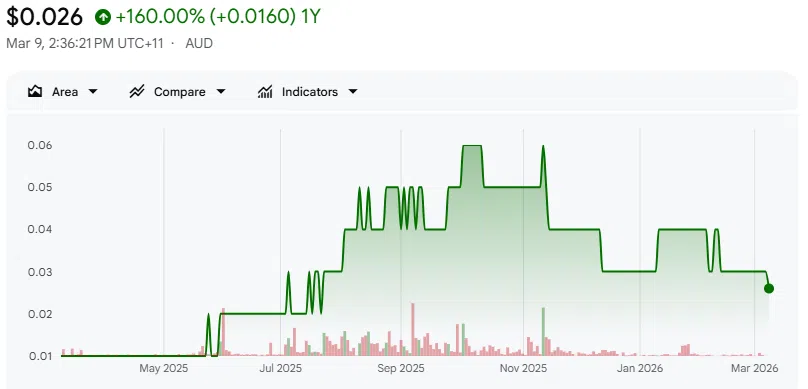
DorsaVi (ASX: DVL)Share Price and News
About DorsaVi
DorsaVi (ASX: DVL) is an Australian technology company with two distinct and complementary growth engines. The company has been operating its wearable sensor business for many years, providing clinicians, occupational health specialists, and researchers with real-time data on human movement and musculoskeletal health.
In 2025, DorsaVi significantly broadened its investment case by exclusively licensing advanced semiconductor memory IP from Nanyang Technological University (NTU) in Singapore. This IP centres around Resistive RAM (ReRAM), an emerging memory technology with meaningful advantages over conventional flash memory and SRAM. From an investor's perspective, DorsaVi is now a high-growth clinical technology play combined with an emerging semiconductor IP angle - a rare combination for an ASX-listed small cap.
DorsaVi's Company History
DorsaVi was founded in Melbourne and listed on the ASX, establishing itself as a pioneer in wearable motion sensor technology. The company developed proprietary sensors and software used to measure and analyse human movement across clinical, occupational health, and sports settings. Its technology was adopted by hospitals, physiotherapists, corporate clients, and sports organisations seeking objective, data-driven movement insights.
A pivotal commercial milestone came with the signing of a five-year agreement with ATI Physical Therapy, the largest chain of physical therapy clinics in the United States, with more than 1,900 clinical sites. This deal marked DorsaVi's first major breakthrough into the US healthcare market and validated its sensor platform at commercial scale, providing a foundation for recurring revenue and broader clinical adoption.
In late 2025, DorsaVi entered an entirely new dimension when it licensed neuromorphic processing-in-memory (PIM) IP from Technion in Israel - technology pioneered by Professor Shahar Kvatinsky, one of the semiconductor industry's most prominent neuromorphic hardware researchers. Shortly after, the company also licensed ReRAM IP from NTU Singapore, positioning itself at the intersection of biosensors, advanced memory, and neuromorphic computing. These acquisitions signalled a clear strategic shift: DorsaVi is building toward next-generation applications in edge-AI and robotics while continuing to grow its established clinical sensor revenue base.
DorsaVi's Future Outlook
The future outlook for DorsaVi is defined by two converging growth drivers: the commercial scaling of its US clinical sensor business and the progressive development of its semiconductor IP portfolio.
On the sensor side, the ATI Physical Therapy partnership provides a significant and scalable near-term revenue pathway. With more than 1,900 US clinical sites, the rollout of DorsaVi's wearable technology across this network represents a meaningful commercial opportunity as adoption deepens and clinical use cases are validated. This existing revenue stream also helps fund the longer-dated semiconductor development program, providing an important degree of financial stability not typically seen in early-stage deep tech companies.
On the semiconductor side, DorsaVi's ReRAM and neuromorphic PIM IP position the company at the forefront of two of the fastest-growing areas of technology. ReRAM offers significant advantages over conventional flash memory - including higher energy efficiency, faster read/write performance, and superior endurance - attributes increasingly critical as AI workloads and data volumes expand globally. The neuromorphic PIM technology goes a step further, integrating computation directly within the memory layer. This architecture enables chips to "sense, think, and act" without relying on external cloud processing, reducing latency, power consumption, and thermal load - characteristics that are directly aligned with what next-generation robotics platforms will require.
Pitt Street Research has set a sum-of-the-parts valuation target of A$0.22 per share - A$0.13 per share attributed to the Sensor business and A$0.09 per share to the ReRAM business. Key share price catalysts include the ReRAM tape-out milestone targeted for the second half of 2026, new semiconductor partnerships or licensing agreements, and additional commercial sensor contracts. The global neuromorphic computing market is forecast to grow from US$5.3bn in 2023 to more than US$20bn by 2030, placing DorsaVi in a high-growth sector at a very early stage of development.
Is DorsaVi (ASX: DVL) a Good Stock to Buy?
We believe DorsaVi presents an interesting speculative opportunity for investors comfortable with early-stage technology risk. The company's dual-engine model - a revenue-generating sensor business paired with an emerging semiconductor IP portfolio - provides a more balanced risk profile than a pure-play deep tech bet.
The commercial traction in the US clinical market adds an important layer of near-term revenue visibility. The five-year ATI Physical Therapy agreement is a meaningful contract that gives the sensor business a clear commercialisation pathway, generating cash flow that supports the semiconductor IP development program running in parallel.
The semiconductor angle, while further out on the development timeline, is where the potential for significant valuation upside lies. DorsaVi's ReRAM IP holds properties that could outperform competing memory technologies on energy efficiency and endurance - particularly relevant as edge computing, AI, and robotics applications demand more capable and power-efficient memory. The tape-out milestone targeted for the second half of 2026 is a key near-term catalyst that investors should monitor closely.
That said, investors should remain aware of the risks. DorsaVi is an early-stage company in its semiconductor ambitions, competing against better-funded players in the ReRAM and neuromorphic computing space. Execution risk is real, and the company will need to demonstrate consistent technical progress while building the specialised talent base required to deliver on its IP roadmap. Funding requirements, while manageable at this stage, may also increase as the program scales toward commercialisation.
Overall, for growth-oriented investors with a multi-year investment horizon and an appetite for speculative technology exposure, DorsaVi's unique combination of proven clinical sensor revenue and high-potential semiconductor IP makes it a compelling small cap to watch - particularly as the 2026 ReRAM milestones approach.
Our Stock Analysis

Breville (ASX:BRG): Will consumer demand for $4500 coffee machines offset the impact of Trump’s tariffs?
Breville (ASX:BRG) is one of those consumer stocks caught in the crosshairs of Trump’s tariffs and fell 30% in 2…

What are the best ASX Consumer Stocks for FY25? Here are our top 5 picks!
It is time to reveal our best ASX Consumer Stocks for FY25! We will be addressing both discretionary and staple…

Here are the 4 best ASX stocks for June 2024
Here are the 4 best ASX stocks for June 2024! Each month, we look at the best ASX stocks of…

Our 5 best ASX stocks for 2024
It is nearly the end of 2023, and so it is time to share our best ASX stocks for 2024!…

The 4 Best ASX stocks for October!
In this article, we look at the best ASX stocks for October. This month we have four choices and underpinning…

Our 5 favourite ASX consumer discretionary stocks!
ASX consumer discretionary stocks have fared terribly over the last 12 months. 4-decade high inflation and rapidly rising interest rates have…
Frequently Asked Questions
DorsaVi (ASX: DVL) operates two distinct business lines. Its core business is a wearable sensor technology platform that measures and analyses human movement for clinical, occupational health, and sports applications. It also holds exclusive rights to ReRAM and neuromorphic processing-in-memory IP, which it is developing for next-generation edge-AI and robotics applications.