
APA Group (ASX:APA): 2025 was the year it turned a pivotal corner; onwards and upwards from here?

APA Group (ASX:APA) investors had a difficult 2 and a half years from mid 2022 to February 2025, but things have improved ever since. High interest rates and regulatory risk around gas plagued investor sentiment. But improved financial results, lower interest rates and a better regulatory situation helped its cause. What does 2026 hold?
What are the Best ASX Stocks to invest in right now?
Check our buy/sell tips

All about APA Group
This company began when it was spun out of AGL over 2 decades ago, when it was the division of AGL that owned the gas pipelines. APA’s network spans 15,000km across Australia and claims to deliver half of the nation’s natural gas usage.
The company also operates gas storage and processing facilities, other power stations and even renewable energy facilities. APA also has investments in other private energy companies. It also has more than 600km of high voltage power transmission lines, storage for 12,000 tonnes of LNG and 18 petajoules of gas, as well as 29,500 gas mains and pipelines for more than 1.4 million customers. On the generation side, it is one of Australia’s biggest renewable energy generators, with 342MW of wind power and 248MW of solar.
One project worth noting is a gas pipeline in the NT to transport gas from the huge Beetaloo Basin resource in the NT. It is one of the three most likely provinces to be developed for large-scale supply. The company has partnered with explorers Tamboran Resources and Daly Waters Energy to deliver it into the established Alice Springs-Darwin pipeline. It is expected to come online in the first half of 2026.
Another area where APA is active is in WA where it is building renewable operations in WA’s mining regions where it hopes to supply the region’s miners. Indeed, it just opened one project in Port Hedland that will supply energy to BHP. Finally, there’s the Basslink electricity cable which lies under the Bass Strait – more regulatory certainty has been key to APA’s recovery, but more on that shortly.
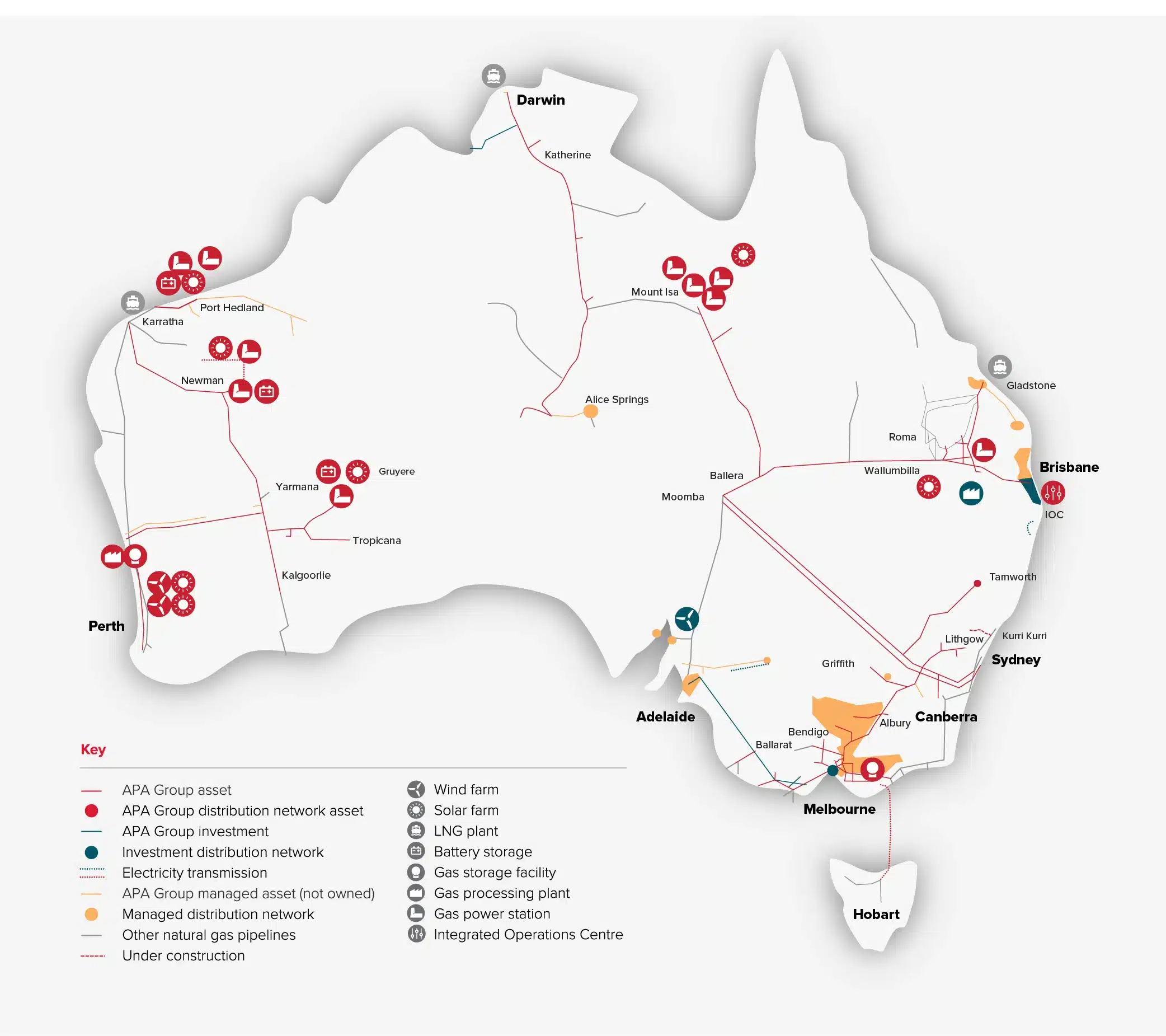
APA Group (ASX:APA) network (Source: Company)
Part of the decarbonisation solution or nothing but part of the problem?
You would think APA Group would have a major role to play in decarbonisation as a gas pipeline operator and renewable energy player. Gas has less carbon intensity and can back up renewable energy when necessary. After all, Australia has a goal of 82% renewable energy by 2030, which means emissions will need to decline by 43% from 2005 levels.
Despite this goal, there’s doubts it can be achieved. Looking to the industry generally, multiple factors are delaying the transition, including slow planning approvals, NIMBYs community opposition and rising costs (not least of which is interest rates but also skilled labour).
As we noted above, the company is both trying to maintain a connection to its roots, while pivoting into renewables. Of course, this is not a cheap exercise, not just in relation to money but also time. Regulation has slowed things down. A hit to investor sentiment came when UniSuper cashed out, selling a cumulative $840m in shares during 2024. UniSuper went out of its way to clarify this was not specifically because it was anti-gas, but to rebalance its portfolio. But it sold the other half only a few weeks afterward. Not exactly a sign of confidence in a company, when its top shareholder sells out – regardless of the reason.
In one sense, it is understandable that UniSuper sold out. As a gas pipeline operator, it is in a heavily capital intensive business, has significant capex requirements, not to mention it is in headlines all the time as it is in the ‘worst of both worlds’ needing to reduce its carbon footprint, but faces scrutiny from regulators and from local residents anywhere anytime it tries to do anything.
Nonetheless, we say again that APA could be part of the solution. It is pivoting into being a power line and renewable energy power generation manager, without entirely walking away from its roots. Gas has been locked in beyond 2050 to support renewable energy, manufacturing and energy exports.
Dividends not really growing much
Looking to APA, it has spent a lot of money recently on new acquisitions and will continue to face high capex. So dividend investors might be disappointed – yes it pays them, but it has not grown them substantially and this has disappointed investors who expect constant dividend growth from top 50 companies. And when you consider the new shares being issued to pay for new acquisitions, this will further dilute investors. Of course if it has too much outflow, it’ll lose its investment-grade credit rating.
What went wrong in 2023 and 2024, then what went right in 2025?
As we noted at the start of the article, high interest rates dragged down the company and all infrastructure and utility stocks generally. Rising rates means higher financing costs and reduce the appeal of stocks (barring the absolute highest yielding) vs bonds. There was also a lot of uncertainty about the regulatory and policy risk around gas as price gaps and domestic reservation was considered. There was also uncertainty over the returns on investments – would they be high enough to justify the high capex, and would they become regulated?
In 2025, rates reduced and this helped its cause. There was also regulatory clarity, especially around Basslink which became a regulated asset – meaning lower risk and more predictable returns. The debate around gas was settled on it being essential as part of the transition. And the FY25 results impressed.
Revenue was $2.7bn, up 4.7%, underlying EBITDA was $2bn, up 6.4% and it paid 57cps in distributions. Its profit was only A$129m, down from $998m a year prior although that result was inflated by $879m mostly due to a write-up of an asset associated with its acquisition of the Pilbara Energy system. The company guided to A$2.12-2.2bn EBITDA and 58cps distributions.
Is there upside?
Analysts covering the company are not so sure. Their mean target price is a discount t the $9.28 per share share price – analysts call for $8.80. Still, they call for 6% revenue growth and 25% profit/EPS growth in FY26, then for 8% revenue growth and another 25% profit frwth in FY27. Its multiples are 47x P/E, 11.9x EV/EBITDA and 4.5x PEG.
The basis for the forecasts in revenue growth are contributions from assets recently completed or nearing completion which include Pilbara Energy System, the Atlas to Reedy Creek Pipeline, the Kurri Kurri lateral pipeline and the Port Hedland Solar and Battery Project. Capacity and other upgrades at existing projects will help too, particularly the Momba to Sydney Ethane Pipeline conversion.
The challenge will be what will happen if rates rise and the company’s interest rate bill rises again, plus investor sentiment takes a dive.
For this reason alone, we wouldn’t invest in the company at the moment, at least not until there’s somewhat more certainty as to where rates are headed – even if there’s more certainty around this company than this time last year.
Blog Categories
Get the Latest Insider Trades on ASX!
Recent Posts

Electro Optic Systems (ASX:EOS) US$42m Slinger Order Lands as Defence Demand Heats Up
New Highs, New Contract, But Valuation Is Now the Debate Electro Optic Systems has pushed to new highs on the…

Sovereign Metals (ASX:SVM) Japan Wants Kasiya Rutile, 70,000 tpa Targeted
Kasiya gets a handshake from a Tier One Trading Partner Sovereign Metals surged 10% today after signing a memorandum of…

Immutep’s Phase 3 trial for Efti has gotten the chop and shares plunge >90%! What now for investors?
After nearly a week in suspense, Immutep (ASX:IMM) confirmed news about Efti that its investors did not want to hear,…