
How Nuclear Energy Became the World’s Most Feared Energy Source

Why Nuclear Energy Still Scares Us and What Really Went Wrong
Many investors may remember periods when nuclear energy captured strong market attention, most notably during the 2006 to 2008 period often referred to as the nuclear renaissance. That phase followed earlier historical peaks, from the atomic age of the 1950s through to the large-scale build-out of nuclear reactors in the early 2000s, when oil prices were trading above A$100 per barrel.
At the time, rising energy costs, growing awareness of climate change, and concerns around energy security combined to support a renewed push toward nuclear power.
Since then, momentum has clearly slowed. Despite its role as a low carbon baseload energy source, nuclear today accounts for only around 9% of global electricity generation, supplied by roughly 440 operating reactors worldwide.
For investors, this raises an important question. What has held nuclear energy back since those earlier peaks, and why has its share of the global energy mix remained relatively constrained despite supportive long term themes such as decarbonisation and energy security?
What are the Best ASX Stocks to invest in right now?
Check our buy/sell tips

The Science Behind Nuclear Power and the Shadow It Carries
Before diving into why nuclear has fallen somewhat out of favour, it is worth stepping back and understanding how nuclear power actually works and why it is considered one of the lowest carbon sources of energy available.
At its core, nuclear energy is generated through a process called nuclear fission. In simple terms, neutrons are fired at extremely high speeds into atoms, causing them to split. Most commercial nuclear reactors use uranium 235, an element that releases an enormous amount of energy when its atoms are split.
What makes this process so powerful is the scale of energy produced from a very small amount of fuel, which allows nuclear plants to generate large volumes of reliable electricity without emitting carbon during operation.
That same scientific breakthrough, however, has a more complex history. While nuclear fission enabled the development of civilian power generation, it also underpinned the creation of nuclear weapons.
What are the fears?
This dual use nature has played a significant role in shaping public perception and policy around nuclear energy, and it remains an important backdrop when considering why adoption has been uneven despite its clear advantages as a low carbon energy source.
An interesting data point that often gets overlooked is just how divided public opinion remains. In the US, sentiment toward nuclear power is almost evenly split, with roughly 49% of Americans in favour and 49% opposed. That tells you this is not a technology rejected on economics alone, but one heavily shaped by perception and fear.
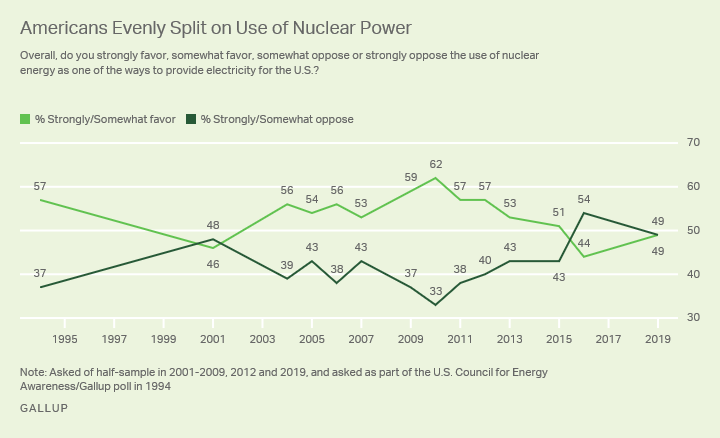
Much of that fear stems from high profile nuclear incidents that have left a lasting imprint on public consciousness. Events such as Chernobyl created a near post apocalyptic image of nuclear power. The idea that radioactive materials can persist for hundreds of thousands to even a million years has reinforced concerns around safety and waste. While Chernobyl ultimately resulted in only a few hundred direct fatalities, the long term exclusion zone and environmental damage shaped how people emotionally assess nuclear risk.
Similar concerns were amplified by the Three Mile Island incident in the US and later by the Fukushima accident in Japan following a major earthquake and tsunami. Even when loss of life was limited or indirect, these events reinforced the narrative that nuclear power carries low probability but high consequence risks.
For many people, the core concern is simple. Nuclear energy produces waste that remains highly radioactive for extremely long periods, far beyond a human lifetime. That characteristic makes nuclear power feel uniquely dangerous, regardless of its strong safety record relative to other energy sources.
What people get wrong about nuclear energy
What is often overlooked in this debate is how nuclear power compares on a like for like safety basis. When you measure death rates per unit of energy produced, brown coal sits among the highest, while nuclear ranks among the lowest. That is a striking comparison. Based purely on energy output, nuclear is statistically one of the safest large scale power sources available, despite the fear it attracts.

It is also important to clarify how nuclear waste is handled. Only around 3% of used nuclear fuel becomes what is commonly referred to as high level waste, and this material is typically stored on site at nuclear power plants. Visually, this waste does not resemble anything dramatic. It is usually in the form of small, solid fuel pellets that are carefully contained and managed under strict regulatory frameworks.
What makes this even more interesting is that this so called waste still contains a significant amount of usable energy. Advanced reactor designs and fuel recycling technologies can reprocess spent fuel and extract additional energy from it, extending fuel life and reducing the overall volume of long lived waste. From an investor perspective, this highlights a key point. Many of the perceived risks around nuclear are driven more by legacy narratives than by current data, technology, or real world safety outcomes.

Blog Categories
Get the Latest Insider Trades on ASX!
Recent Posts

ASX Travel Stocks Explode Higher as Oil Crashes 15% on Iran Ceasefire- Is This a Buy or a Two-Week Trade?
ASX Travel Stocks Rally on Ceasefire Oil Drop Virgin Australia (ASX:VGN) surged 13%. Qantas (ASX:QAN) jumped 8%. Flight Centre (ASX:FLT)…

Fortescue (ASX:FMG) Drops on Diesel Supply Crisis- Is Andrew Forrest’s Green Pivot Hurting FMG Shareholders?
Fortescue Falls on Diesel Supply Fears Fortescue (ASX: FMG) shares fell 1.32% to A$20.26 in Friday’s session as the mining…

Iron Ore Falls to $103 on China’s Near-Record Stockpiles- What It Means for ASX Mining Stocks
ASX Mining Stocks Under Pressure as Iron Ore Falls Iron ore has slipped to around US$103 per tonne on the…